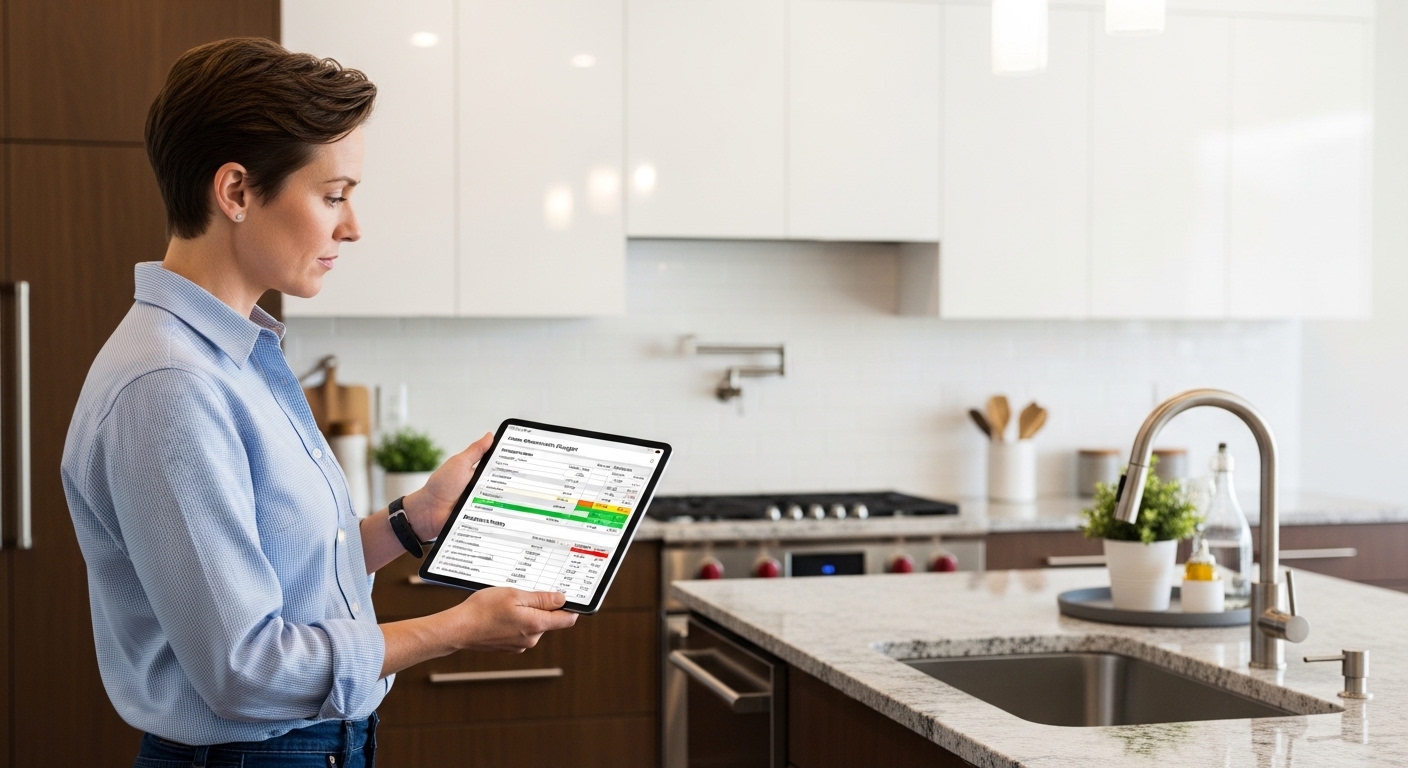
That gorgeous marble island-top kitchen. The hot tub bubbling away on a fresh patio. A spa-like master bath with heated floors. I get it—when you're thinking about improvements for your home, your imagination tends to run wild with all the amazing possibilities. The challenge is that dream finishes often don't translate into actual home value when you eventually sell. Before you start picking out premium fixtures and booking contractors, it's time to talk about something less glamorous but infinitely more important: creating a realistic renovation budget.
Most homeowners don't realize that renovation spending isn't just about what feels right in the moment. Every dollar you invest should be evaluated against what you'll realistically recoup if you sell your home in a few years. Without a clear budget and strategy, you can easily end up spending tens of thousands of dollars on upgrades that won't pay for themselves when it's time to list.
The 30% Rule: Your First Budget Checkpoint
A remodeling project generally shouldn't exceed 30% of your home's current value if you want to maintain a positive ROI. On a $300,000 home, that means capping any single project at roughly $90,000. This is a useful baseline for Medina County homeowners who are just starting to think about renovation scope.
But here's what's important: that 30% rule is just your ceiling, not your target. Many homeowners find that sweet spot sits significantly lower. Start with realistic budgeting that includes 10 to 20% contingency for unexpected costs. Hidden surprises—outdated wiring that needs replacement, plumbing issues behind walls, structural concerns—pop up constantly in renovation projects, especially in our older Medina County homes.
Stop Chasing 100% ROI
Here's a mindset shift that will save you money: you don't need to recover every dollar you spend on a renovation. In fact, expecting to do so is unrealistic for most projects.
Minor remodels average 96% ROI and major remodels around 50% ROI. For kitchen work specifically, minor kitchen remodels return around 113% of their cost nationally, which includes keeping the existing cabinet boxes and refacing fronts, updating countertops, and swapping in new appliances. The moment you start moving walls and gutting the entire space, that ROI drops dramatically. If you start moving walls and tearing everything down to the studs, the return drops to about 50%.
Why? Because buyers don't always value the expensive, custom work the way you do. What they notice are the visible, surface-level upgrades that make a home feel modern and well-maintained.
Which Projects Give You the Most Bang for Your Buck
If you're planning to sell your home in the next few years, not all renovation projects deliver equal returns. Replacing a garage door gives you the best return on investment (ROI) at 268%. Replacing a steel entry door (216%) and adding manufactured stone veneer (208%) are close behind. These exterior projects are attention-getters that signal curb appeal to potential buyers.
For interior work, kitchen and bathroom updates consistently deliver solid returns. Small changes to the kitchen can get you back about 113% of what you spent, which makes them the best way to get your money back on an interior renovation. Bathrooms also perform well. Mid-range bathroom remodels deliver 65-80% ROI, making them one of the strongest home improvement investments. This means a $25,000 remodel adds $16,250-$20,000 to your home's resale value.
When you're planning bathroom work, remember that you don't need to chase the luxury spa dream. The resale value for luxury spaces is significantly lower. Most upscale renovations return only 41.7% to 45.1% of the investment. A clean, updated bathroom will outperform a custom marble paradise every time in terms of actual dollars recouped.
Kitchen Spending: More Restraint, More Returns
Kitchens deserve their own section because so many homeowners stumble here. This is where I see the biggest disconnect between renovation dreams and renovation reality.
The national average kitchen remodel costs around $27,000 to $35,000, with most projects falling between $15,000 and $75,000 depending on size, scope, and finish level. But here's what surprises people: spending more doesn't always mean getting better ROI. In fact, it often works backwards.
Once a kitchen reads as "nice," extra spending stops translating into extra value. Kitchen Cabinet Kings' 2026 ROI report describes this as the point where renovation shifts from investment to indulgence. The difference between a kitchen that looks dated and one that looks current doesn't require a six-figure gut renovation. Cabinet refacing, hardware, lighting, and paint are among the highest-return kitchen changes.
Cabinetry usually takes up the largest share of a kitchen remodel budget, about 30 to 40 percent of the total. If your cabinets are structurally sound but tired-looking, refacing them can give you the visual impact of new cabinets for a fraction of the cost.
Plan Your Scope Before You Talk to Contractors
One of the biggest budget mistakes I see is getting quotes from contractors without having a clear picture of what you actually want done. Different contractors interpret vague requests differently, and suddenly you're comparing a $20,000 project to a $50,000 project for supposedly the same work.
Write out your renovation scope in plain language. Include what you are keeping, what you are replacing, what quality level you want (budget/standard/premium), and any specific products or brands you have in mind. This written scope becomes the basis for every contractor quote—ensuring you are comparing apples to apples.
This approach also forces you to think through your priorities. Is new cabinetry non-negotiable but countertops less important? Do you need new plumbing or is the existing layout fine? Getting specific about these decisions before you start shopping prevents you from making emotional choices at the showroom that blow your budget.
Account for Your Local Market
Renovation costs vary by 30–60% across US states due to labor rate differences. This means what makes sense as a renovation budget in one part of Ohio might be completely different in another. Your Medina County real estate market has its own character, and smart renovation planning means aligning your project scope with neighborhood standards.
When you list your home, you're competing against other Medina County homes in your price range. Match kitchen quality to neighborhood norms. Over-improving for your market rarely pays back. A $100,000 kitchen in a neighborhood where the median home price is $250,000 is almost certainly a money loser. You want improvements that feel current and appealing without standing out as dramatically over-improved compared to your neighbors.
Fix What's Broken Before You Upgrade What's Beautiful
This one sounds obvious, but I can't tell you how many homeowners I've worked with who invested heavily in cosmetic upgrades while ignoring underlying issues. Fix what's broken first. Cosmetic upgrades mean little if inspectors flag a failing roof, outdated electrical panel, or plumbing issues.
A shiny kitchen doesn't matter if the foundation has problems or the HVAC system is on its last legs. Buyers will walk away from beautiful cosmetics if the home inspection reveals deferred maintenance. Your renovation budget should prioritize functional systems before finishing touches.
Financing Your Renovation Without Destroying Your Budget
Most renovations require financing beyond savings alone. 54% of homeowners use HELOC (Home Equity Line of Credit) or home equity loan options to fund renovations. The average American homeowner has approximately $150,000 in home equity gains over the past five years, providing substantial borrowing capacity.
If you're financing a renovation, the structure of that financing matters. For projects over $20,000, a HELOC or home equity loan typically offers better rates than personal loans, which means lower monthly payments and less money spent on interest.
Work With Someone Who Knows Your Local Market
This is where I come in. As your Medina County real estate expert, I understand what buyers are looking for in our market. I know which neighborhoods support kitchen renovations and which ones don't. I can tell you whether that master bath expansion makes sense for your home or if it's overkill for your area.
Before you commit to any renovation project, it's worth having a conversation with a real estate agent who knows your market intimately. Pull up comparable sales in your neighborhood using HOUSEJET, and see what similar homes are selling for with and without the upgrades you're considering. That data is gold—it takes emotion out of the decision and replaces it with actual market information.
I've guided many Medina County homeowners through renovation decisions, and the ones who get it right are the ones who plan carefully, set a realistic budget, and stay focused on what actually matters to buyers in our area. Your home should feel amazing to you personally. But if you're planning to sell in a few years, every renovation decision should be filtered through one question: will this add value proportional to what I'm spending?
If you're thinking about renovations and want to discuss what makes sense for your specific property and timeline, I'd love to talk. Let's make sure your hard-earned money goes toward improvements that truly pay off.